
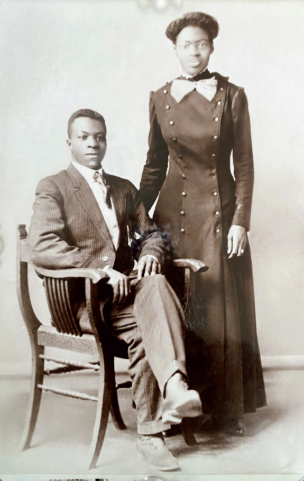
Isaac & Ida Madison
The foundation of the Madison family — orphans from Roanoke who built something extraordinary
“This family was founded by Isaac & Ida (White) Madison. They were born orphans. Our family’s history will make our whole family proud and should inspire all of us to continue to strive and move upwards the way they did.”
— From the Madison Family History presentation, “Know Your Family’s Worth”
Every family has a starting point — a generation that arrived with nothing and built something that echoed forward for decades. For the Madison family, that starting point is Isaac and Ida (White) Madison, two orphans born in Roanoke, Virginia, who found each other, moved north, and raised eight children through the hardest years America ever put its people through.
This is their story.
Roanoke, Virginia — The Beginning
Isaac and Ida were both born in Roanoke, Virginia — a city that carries its own weight of history. They were both raised as orphans, which meant they came into adulthood without the safety net most people take for granted: no inheritance, no family land, no one to call in a favor. What they built, they built entirely from scratch.
During his early childhood, Isaac lived in Braddock, Pennsylvania, raised by his aunt on his mother’s side. It was there that he learned his lifelong trade: bricklaying. But it was also there that he began developing a gift that would define his entire life — an extraordinary natural ear for language.
The Man Who Taught Himself Seven Languages
Braddock and the surrounding Pennsylvania steel towns in the early 1900s were among the most ethnically diverse places in America. Waves of immigrants from Italy, Slovakia, Poland, Hungary, and across Eastern Europe had come to work the mills, and they brought their languages with them. Isaac listened. He watched. He absorbed.
By the time he was a working man, Isaac Madison had taught himself seven languages — Italian, Slavic, Polish, Hungarian, and several others — by paying close attention to the immigrant workers around him. This wasn’t a formal education. It was pure will and a remarkable natural ability.
He had a natural “ear” for languages, and all of those he learned were of the indigenous population of the many immigrants who settled in the area to work in the steel mills.
— Madison Family History
This skill would open every door that racism tried to close.
The First Black Bricklayer at Carnegie-Illinois Steel
When Isaac arrived at what was then Carnegie Steel (later Carnegie-Illinois Steel, then U.S. Steel), the foreman told him he’d be placed in the brickmason department — but not as a bricklayer. The assumption was that a Black man could assist but not lead.
Isaac pushed back. He told the foreman directly: “I can lay brick.” The foreman didn’t believe him, but gave him a chance to prove himself. He did. Isaac Madison became the first Black bricklayer at the Carnegie-Illinois Steel Company, his job consisting of replacing the fire brick in blast furnaces — dangerous, skilled, physically demanding work that required both craft and nerve.
His path in was his languages. Many of the bricklayers in the plant were Italian. Isaac had watched them work and listened to them talk, and he knew exactly what they were doing and how they did it. When he told the foreman he could lay brick, he wasn’t guessing.
Two Stories Worth Telling Forever
The family history preserves two stories about Isaac that deserve to be passed down through every generation.
The first: Isaac was working with an Italian crew that didn’t know he spoke their language. One of them said in Italian, “Let’s brick this n—– up in this furnace.” Isaac said nothing. He simply began working twice as fast, and finished his side of the job before they finished theirs. When they asked him — in English — why he was working so fast, he answered them in Italian.
The second: Isaac was in a restaurant with a group of Italian friends, all speaking Italian together. The owner told them Isaac couldn’t be served because he was “colored.” His friends told the owner, “He isn’t colored, he’s Italian” — since they were all speaking Italian together, the owner believed them. Isaac was served. When the meal was done and the bill was paid, Isaac turned to the owner and told him — in perfect English — that he had enjoyed the meal very much.
“He answered them in Italian.”
Isaac Madison, first Black bricklayer, Carnegie-Illinois Steel
Ida — “Just a Housewife”
The family history presentation addresses Ida’s role with the directness it deserves:
“Just a housewife.” That statement is one of the most understated phrases that could ever be written. Think of raising eight children in the middle of the worst depression this country has ever known. Think about caring for a husband coming home tired after working in the steel mills. Think about all the colds, scratches, mosquito bites, cuts and scrapes she doctored. Think about all the lunches she packed, all the clothes she washed and mended, all the meals for a family of TEN. Day in and day out for about 20 years. Now, can we honestly say, “She was just a housewife”?
— Madison Family History
Ida (White) Madison raised eight children: Benjamin (1912), Ralph (1914), Isaac Jr. (1915), Hazel (1918), Carl (1920), twins Earl and Pearl (1922 — Earl passed away a month after birth), Lawrence (1925), and Lelia (1932). She did this while Isaac worked twelve-hour shifts at the mill, through the Great Depression, through strikes, through layoffs, through every hardship that Youngstown’s working families faced in the first half of the twentieth century.
The family history puts it plainly: Isaac and Ida didn’t just raise children. They formed a “Madison Family Foundation” — a great parental team whose values and example echoed through every generation that followed.
The Family They Built
From Isaac and Ida, the Madison family grew across five generations:
Know Your Family’s Worth
The phrase “Know Your Family’s Worth” runs through the Madison family history presentation like a refrain — and it means something specific. It means knowing that you come from people who arrived with nothing and built everything. People who faced closed doors and found ways through. People who were told what they couldn’t be and became it anyway.
Isaac Madison taught himself seven languages in the mill towns of Pennsylvania and used that gift to break barriers that were meant to hold him. Ida Madison held a family of ten together through the Depression with grace and endurance that no title could adequately describe. Together they are the reason the Madison family exists — five generations and counting, spread across the country, each one standing on the foundation they built.
Also in this series
→ Ralph Madison — Isaac & Ida’s son, steelworker, deputy, father (includes original 1985 audio recording)
→ Florence Madison — Ralph’s wife, from Greenville, Alabama to Youngstown, Ohio