
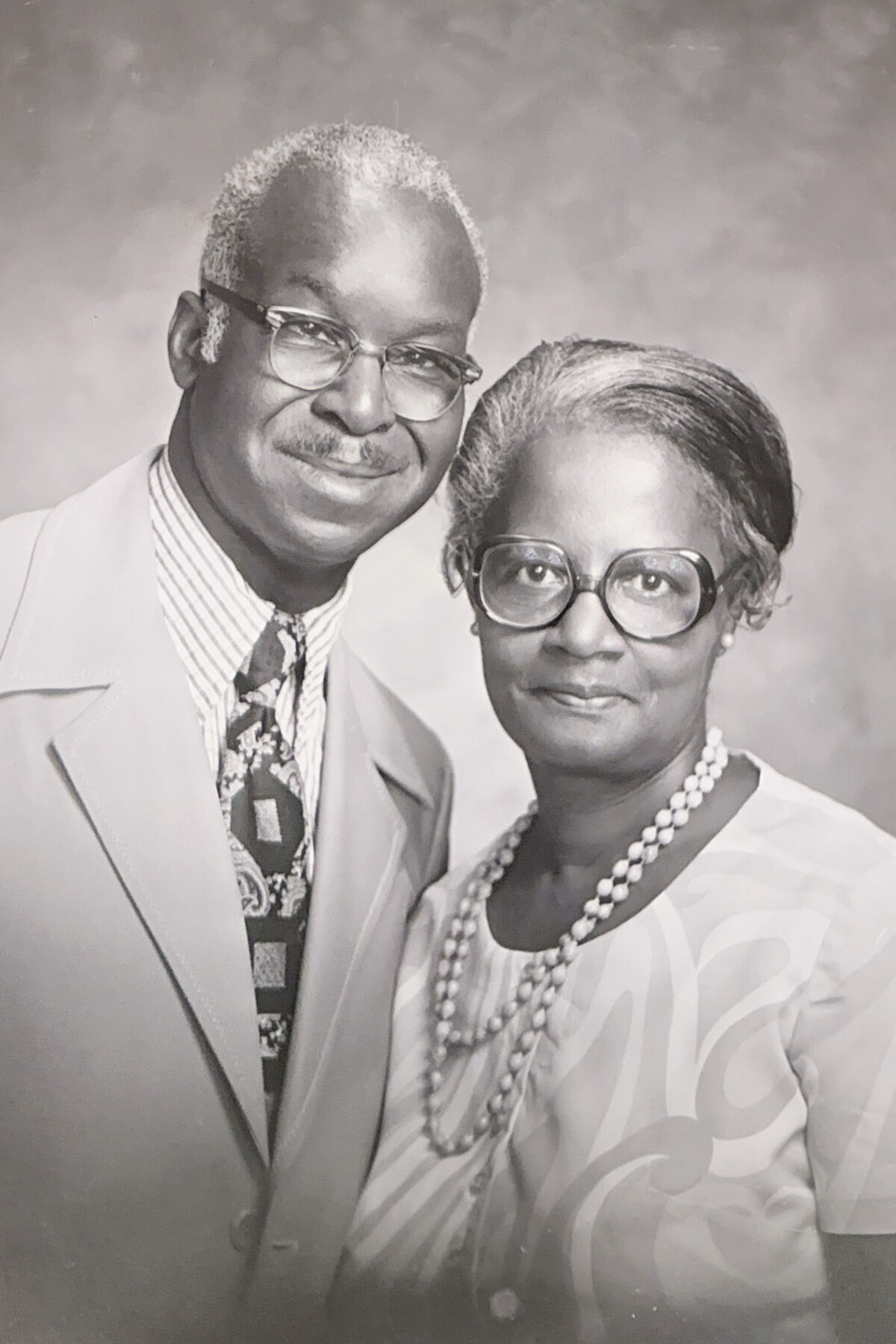
Ralph Madison
Steelworker, deputy, father — Youngstown born and bred
This interview was recorded just 26 days before his passing.
Interviewee: Ralph Madison | Interviewer: Joseph Drobney, Youngstown State University
Date: October 22, 1985 | Location: 2634 Stocker Avenue, Youngstown, OH
Program: YSU Oral History Program — Westlake Terrace Project (O.H. 770)
Subject: Resident conditions, Civilian Conservation Corps, life in Youngstown
Ralph Madison was born on March 7, 1914, on the south side of Youngstown, Ohio — the second-oldest boy among eight children born to Isaac and Ida Madison. He grew up in a working-class neighborhood on Earle Avenue, delivered newspapers, watched his city transform through the Depression and two World Wars, spent 36 years working for U.S. Steel Corporation, served as a Mahoning County Sheriff’s Deputy for eleven years, and raised four children with his wife Florence in the Westlake Terrace Housing Project.
On October 22, 1985, he sat down with historian Joseph Drobney at the family home on Stocker Avenue for what would be one of the last long conversations of his life. He died 26 days later, on November 17, 1985. His interviewer, Drobney, noted afterward that Ralph was “an articulate, easy to talk to individual who made this interviewer’s job truly a pleasure.” What follows is a narrative drawn from that recorded conversation.
Growing Up on the South Side
Ralph’s earliest memories were of the south side of Youngstown — a mixed neighborhood where steelworkers, streetcar conductors, and tradespeople of many ethnic backgrounds lived side by side on Earle Avenue. His father, Isaac, had come to Youngstown from Pennsylvania, where he had worked as a bricklayer. When he arrived at what was then Carnegie Steel (later U.S. Steel), he was told he’d be placed in the brickmason department — but not as a bricklayer. Isaac pushed back, and eventually prevailed: he became the only Black bricklayer at the plant for years. He also spoke Italian, Slovak, and Croatian fluently, which made him invaluable at safety meetings where immigrant workers couldn’t understand English instructions. “People would be surprised,” Ralph recalled. “They would say that he spoke their language better than they did. Everyone knew Isaac because of that.”
Ralph attended Delason Grade School and Princeton Junior High before finishing at South High School in 1933. He was one of just six Black students in a graduating class of over 200. He delivered the Vindicator newspaper on his way home from school each day, picking up his papers near the school and walking his route back to Earle Avenue. He liked school — liked his teachers, liked being close to home — and would have stayed longer if circumstances had allowed.
Segregation in Plain Sight
Youngstown in the 1920s and ’30s was a city alive with activity — but it enforced its racial boundaries quietly and thoroughly. Downtown theaters admitted Black patrons but sold them tickets only for the balcony or the rear. “You knew just where you would go to sit,” Ralph recalled. “They didn’t say it. They only sold you tickets to certain places.” The Palace Theater, the Strand, and the Park Theater all operated this way. Certain restaurants would not serve Black customers at all.
“There were certain places that you didn’t go, and there were a lot of places that you could go. In some theaters and restaurants you didn’t go in.”
— Ralph Madison
Black Youngstownians had their own spaces — all-Black venues, certain beer gardens — but the broader civic life of the city was divided in ways that went largely unspoken and largely uncontested, because challenging them carried real risk.
The Depression and the CCC
When Ralph graduated high school in 1933, the Depression was still grinding on. His father was laid off intermittently — sometimes working a day or two on a pay, sometimes nothing. The family relied on soup kitchens that operated along the Sharon Line streetcar route. Ralph remembered pulling a child’s wagon to the distribution point to collect food commodities — flour, grapefruit, whatever was being given out that week.
Shortly after graduation, a classmate told Ralph about the Civilian Conservation Corps and asked if he wanted to sign up. He said yes. The next Monday they went down; Wednesday they left. Ralph spent a year and a half in the CCC — driving trucks and doing manual labor — before deciding he’d had enough. His father told him the mill was no place for a young man, but Ralph wanted steady money. He started at U.S. Steel’s Ohio Works in 1936 as a general laborer, making $3.76 a day for ten-hour shifts, six days a week, with no overtime, no union, and no benefits to speak of.
Inside the Mill
The conditions Ralph described in the mill were brutal by any measure. Workers entered open-hearth furnaces — massive structures heated to extreme temperatures — and dismantled them by hand with bars and shovels, throwing bricks while wearing only hand pads. The bricks were hot enough to burn through shoes. “Sometimes the shoes were burnt anyway when you came out,” he said matter-of-factly. If you got hurt, you were sent to a hospital — but there was no real safety infrastructure, and getting hurt might mean losing your job.
Foremen actively discouraged talk about unionizing, threatening workers with termination if they showed interest. When organizers finally began appearing at the plant gates in the late 1930s, things were tense. The big 1937 strike — which brought National Guard troops marching through Brier Hill and around Sheet & Tube — touched Ralph’s life at a distance; he’d already been laid off and watched soldiers patrolling the streets as a bystander. When the union finally came to Ohio Works around 1940, wages jumped from roughly $3 a day to $5, and the eight-hour workday arrived. “Things did get better, definitely,” Ralph said.
Marriage and Westlake Terrace
Ralph married Florence in 1938. The newlyweds rented a room on Harlem Street, then an apartment on Griffith Street across from where the Westlake Terrace project would be built. When construction began, Ralph watched from across the street as the old Morrison Hill neighborhood — houses called “shotgun houses” because you could see straight through them — was torn down and the new project rose in its place.
They moved into Westlake on June 26, 1940, with a young baby and furniture scrounged from Florence’s uncle’s moving company. The apartment came with a refrigerator and a stove — they brought everything else. Ralph had to present his marriage license, utility bills, and proof of employment at the office on West Federal Street to qualify. Rent was set at one-quarter of monthly income, starting around $18.75 a month.
“It was a good place to live. It was a first permanent home for you and your wife.”
“Right, and I never regret it.”
— Exchange between interviewer Joseph Drobney and Ralph Madison, at the close of the interview
Ralph served as a tenant council representative for his four-building section of the project, holding a key to the laundry room and meeting regularly with Youngstown Metropolitan Housing Authority officials — including Paul Strait, the YMHA director who made a habit of walking through the project and talking with residents. Ralph had a civic instincts and a quiet authority; he was the kind of person institutions trusted with responsibility.
War Years and After
When World War II came, the mill got Ralph a deferment because he ran certain specialized machinery. U.S. Steel shifted entirely to war production — steel going directly into materiel. Wages were frozen by wartime government policy; the union cooperated. Women came into the mill in significant numbers for the first time, running cranes, unloading boxcars, digging ditches alongside men. Some stayed after the war; most who had taken the heavier jobs left.
By the late 1940s and early 1950s, Ralph noticed the project changing. The original residents — young couples who had moved in around 1940 and 1941 and built their stability there — were beginning to leave as soon as they could buy or rent something better. Ralph worked two jobs to save enough to get out. He and Florence eventually moved to the lot they’d bought on Stocker Avenue, leaving Westlake in 1953.
After 36 years at U.S. Steel, Ralph went on to work at Bliss Manufacturing from 1972 to 1974, and then spent eleven years as a Mahoning County Sheriff’s Deputy. He was still living on Stocker Avenue — the address to which YSU mailed the transcript of his interview — when he died on November 17, 1985.
A Voice Preserved
Ralph Madison’s interview with Joseph Drobney runs to 27 typed pages of careful, specific memory. He remembered prices — the 8 or 10 cent trolley fare, the $3.76 daily wage, the $18.75 rent — with the precision of a man who had lived close enough to the financial edge that numbers mattered. He remembered names, streets, the layout of neighborhoods long since demolished. He spoke without bitterness about the segregation he had navigated his entire life, and with genuine warmth about the community that had formed in Westlake Terrace during its early years.
The recording of his voice — digitized from the original tape — is embedded above. Listen to him speak in his own words, on one of the last mornings he had to give.
Also in this series: Florence Madison — From Greenville, Alabama to Youngstown, Ohio